Pages

Translate

Friday, March 13, 2020

DMIC Professional development

Day 1 of DMIC 


  • Recognise that culture and maths are intertwined
  • Connected rich mathematical thinking
  • Proficient use of mathematical practises
  • Inquiry learning within mathematics
  • Social grouping
  • High expectations and inclusion
  • culturally sustaining teaching and learning
  • Co-constructing teaching, co-constructing learning


Discussion around groupings of children was interesting and I was concerned that my higher ability children would not be challenged.  I am keeping an open mind......


Tips and Tricks

  • When writing problems makes sure you use the culture of someone in your class. Everyday there will be a star.
  • Set whānau task to take photos of mathematical things in their house and send back to class.
  • Warm ups are to be completely unrelated to the task you are teaching.


How to set up your class


No more than 16 in group working.
Felt pens
One pen one recording book.
No one is left behind you are working as a whānau group no one is the passenger no one is the leader.


What do you do with the other half of the class?


Useful links


Warm Ups


What mathematical ideas do you see here? ½ ¼ whole?????


Thursday, March 12, 2020

DFI Day 1

Deep Dive #1     Google Groups

What?
I was introduced to the benefits of using Google Groups for communicating with whānau and teachers using one email address.

Why?
It ensures no one is left out, easy to share docs, time efficient, you don't need a gmail or a google account. You can search the thread using tags.

When will I use this?
I see this as a great way to send out class emails to whānau while still keeping their privacy intact. To email teachers within a group, syndicate.


Deep Dive #2     Chrome & Google   
Google Drive
Chrome


  • Control shift B bookmark tabs
  • When you set up folders you can set permissions
  • Shift z will share new stuff in your drive to 2 places (add here not move) ghosted link to other folder
  • Colour code and number folders rather than in alphabetical order. Create new year folders with asterix so that they appear first.


What?
Loads of tips to make work flow more efficient.


  • Drag lock down
  • Jump between tabs by hitting control and then the number 
  • Extra tip delete the words after bookmark and just have the logo to free up space on bookmark bar.
Why?
To be more organised and time efficient. To be able to find things easier. To keep my drive organised and easy to navigate.


When will I use this?

Everyday!


Deep Dive #3 Voice typing

What? 
Voice typing is a must for our boys. It is a great way for tamariki to get their ideas down without the barrier of not knowing how to spell or touch type well. 
You can type into Google docs and slides by using your voice.


Why?
When will I use this?


Writing is hard and it can be a struggle for writers of all ages. 

I can see this being a great too to use with our boys especially and 
also as a reading aloud activity to keep and eye on fluency.


Deep Dive #4                  Chrome Extensions


What?
Lots of tried and tested extensions to make life easier! 
Click on the link to see what's on offer Amazing tried and tested chrome extensions for docs.

Why?
To get the best bang for buck. To make learning exciting and keep tamariki engaged and motived.

When will I use this?
Whenever we need to 'pimp' our lessons, planning, bog posts, resources.


Deep Dive #5         Using Google Docs to Create 


What?
You can use Google Docs to create amazing graphics and resources.


Why?
Most useful tip for me was to use a table and then insert an image or text into individual cells. This way it keeps the resource tidy, well balanced and easy on the eye.


It's great to learn some tips and tricks to make your resources look professional.  


I also learnt how to merge cells easily and refreshed my skill on remove background.

When will I use this?
Especially useful in the digital create phase of Learn, Create, Share.

A fantastic day loads of manaakitanga and shared knowledge with a great group of new colleagues.


Tuesday, February 25, 2020

PLG #1 2020

Our first PLG this afternoon was awesome. We shared our hunches, learnt a bit about each other and our classrooms and got through a reading on Reciprocal Teaching using the Quartet Inquiry discussion model (see below).
We plan to touch bases via email in a few weeks to share the 'gold' happening in our classrooms. The start of an exciting journey.

Friday, October 25, 2019

Professional Learning Groups Uru Mānuka 2019

Working across the cluster with other teachers this year has been a great experience.  The purpose of this inquiry was:
Purpose: Together the Professional Learning Community will build deep understanding of the Inquiry Process, Assessment for Learning and the Topic of the Inquiry. Together we will develop and expand effective teaching and learning practice across the cluster to accelerate or raise learning in your chosen areas. 

Our overarching question was...

Can deliberately engaging students in how to/ explicitly teaching students how to….


Give and receive Feedback


Accelerate or raise student achievement against norms? 


Friday, June 7, 2019

UC Child Wellbeing Research Symposium

I attended the UC Child Wellbeing Research Symposium 6-7 June and got the chance to listen to some great keynote speakers. I found Laura Justice very interesting and following are some notes to summarise key points that I will reflect on.


Laura Justice
Neuroscience
Experiences are crucial for development of neuro pathways.


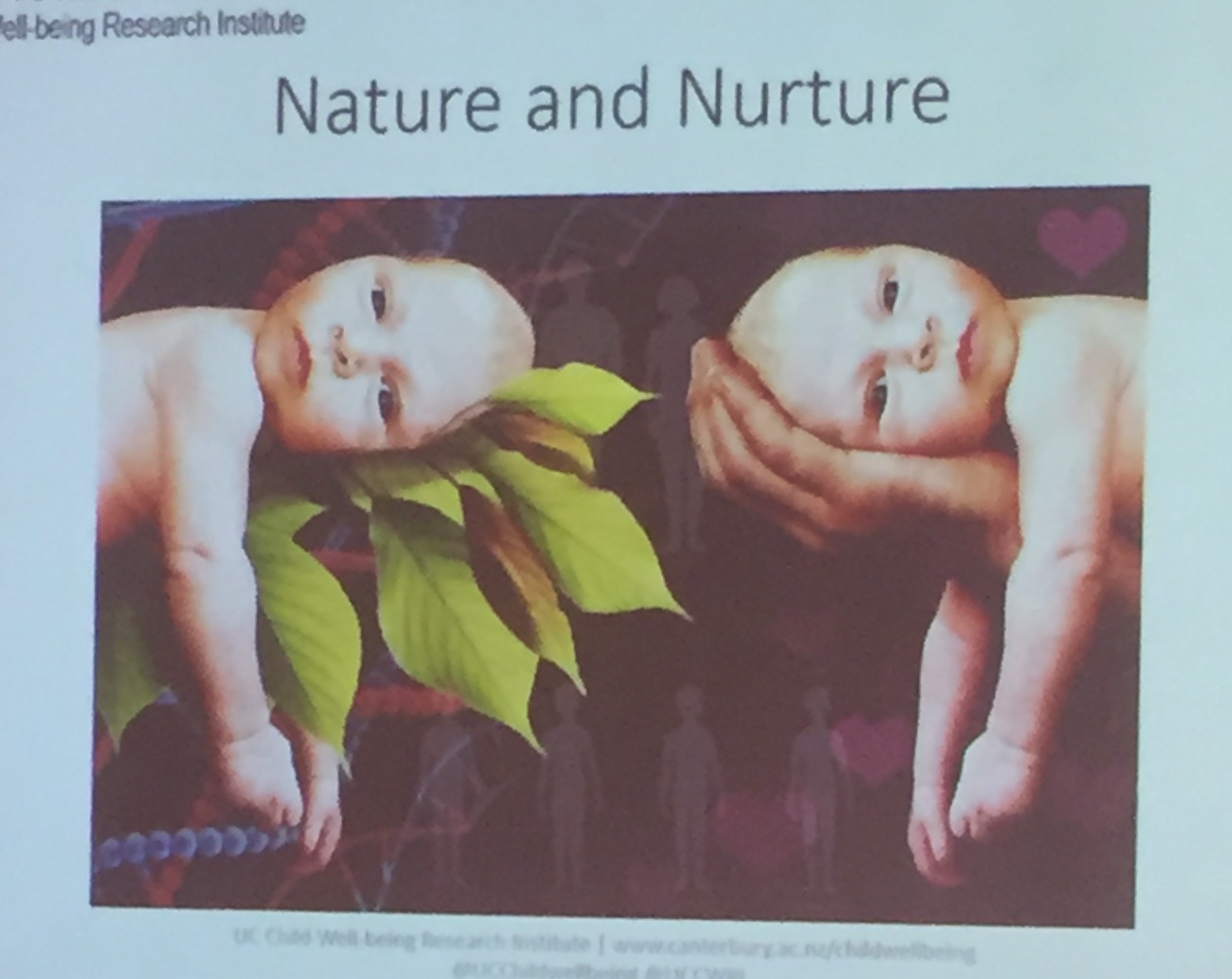
Nature and Nurture


Structural brain changes are due to early experiences. Laura focused on how being reared
in poor situations (poverty) affects the brain. In her study she looked at food insecurity which
was a phrase that I hadn't heard of before basically referring to an ongoing lack on food in
the house. Food desserts were another new concept to me, described as areas where people
live that have no fresh food available, no supermarkets or places to purchase quality food.
For many whānau in this situation, serious mental health issues can develop. Tamariki raised
in these situations are being exposed to toxic stress or ongoing high levels of stress correlated
with the caregivers stress. Their regulatory system is on fire. The brain of the tamaiti is
being altered by being exposed to living in poverty environments. A current research paper
published refers to this A Brain on Poverty Noble 2017        Noble 2017


Linguistics
Achievement or opportunity gaps in vocabulary are largely due to lack of experiences. HIgh quality experiences are crucial for buffering the effects of early adversity on the child’s brain.

Education
Joint attention was discussed and this is when an adult and a child are sharing a focus these periods are really crucial for language
development. Serve and return develops the brain circuitry/pathways. If you think of playing
table tennis, serve and return is when the conversation is bounced back and forth between
adult and child or child and child.

On average, classroom conversations or serve and return were 4 turns.This is especially
important to understand in play based learning as you have to ensure that the conversations taking place a extended if they are to develop vocabulary of the child.

Wednesday, December 12, 2018

A summary of my journey


This year has been an amazing journey for me, I have extended myself out of my comfort zone and written a children's picture book with the children in my class. Been given the opportunity by KPMG and the time and guidance of my peers I have contributed to the pool of key competency resources available to our teachers in Aotearoa.

A short video of my journey and the resource that I have developed is below. If you would prefer to have a pdf copy of the book to read at your leisure please click on the link provided. Feel free to share as you wish.

Mauri ora
Heather

My Journey KPMG MIT 2018                 


How to become a better self manager book

Wednesday, August 15, 2018

Reflecting on my own learning.....

This term I have embarked on an intensive language professional development course and as I was driving to school I was reflecting on my journey this term as an adult learner. I realised that when learning something new and quite complicated that stories are a really good way to solidify the knowledge and make it easier to recall information.  Then I had an idea... if this works for me, and I know it has worked for the tamariki in the past to recall knowledge,  maybe it is the pathway I need to take to further the development of a resource for my inquiry.

 So I am looking to use a legend as a metaphor for self management and retell this as a digital book, linking specific parts of the story to self management characteristics.

I want to use our staff at Hornby Primary School, the tamariki and also art work that the tamariki have created  to illustrate the digital book. Time to prepare a storyboard. The legend will be in the middle of the book somehow and the tamariki will discuss the legend, learn some strategies from it and use these to make change for the better.

Time to storyboard and get the planning underway...

I took some photos, a short video and captured the tamariki's wonderful artwork to illustrate the book. At this time I hadn't really decided on which legend I was going to use and I had a play around with a couple of different ones. I eventually ended up using the legend of Nukutāwhiti and how he voyaged to Aotearoa.  Because I work in a bilingual classroom, it was important for me to develop this resource for the tamariki through both a mainstream and a Māori lens.

It took ages to pull it all together but I was really happy with the finished product which is below.

My next step is to create a unit plan with a variety of lessons that can be used to further develop the self management key competency.

Prior to developing this resource I got the tamariki to take a questionnaire about their attitude  in the classroom with a focus on key competencies. After working with the resource,  I plan to get them to retake the questionnaire again in Term 4 and analyse that data.

Self Manager Book Click on this link to view storybook