Pages

Translate

Showing posts with label Spark MIT 16. Show all posts

Monday, May 16, 2016

SPARK MIT 16 Hui 2

Another great day was spent at the Spark HQ listening and supporting each other on our inquiry pathways.  A huge thank you to Spark for the wonderful manaakitanga provided, the space was wonderful and the food delicious.

It was a good chance to share ideas and collaborate professionally on where we are at and where to next.

SAMR


Discussion around where our inquiry fits on the SAMR ladder was very valuable. There were a couple of great resources, links  that I felt explained the model for me, one was the SAMR wheel  and the other was an analogy of Taking a Dip in the SAMR Swimming Pool.  They both got me thinking about how I can move my pedagogy from "best practise" or enhancement in the shallow end  to transformative in the deep end.  Lots of food for thought.

Progress on 'My Inquiry'

My inquiry has developed into a 2 pronged inquiry with the quality of the vocabulary being one prong and the recording and presenting of the virtual or real experience being the other.

I have already used a couple of interventions to assist with the quality of vocabulary including using a split screen to enable the children to view the collaborative word lists that we have created alongside their writing. They are also learning how to use and online thesaurus to provide richer vocabulary.

We will be taking a collection of quality photos on our next EOTC experience combined with screencastify,
 and this will provide them with not only a visual prompt for them to write on when they return but also the scaffolding required for when they take photos of an experience at home. They will share this at school and then it will be a prompt for their writing.

The next step for my blogging will be to provide some links to evidence of my interventions so that others can share the ideas.

Some of the other ideas that I will be using shared by others in the group are using teacher dashboard as a visible, motivational, scaffolding tool in writing. I can't wait to give this a go and also using comic creator templates as another writing tool.



Sunday, May 15, 2016

Baseline Data Sample

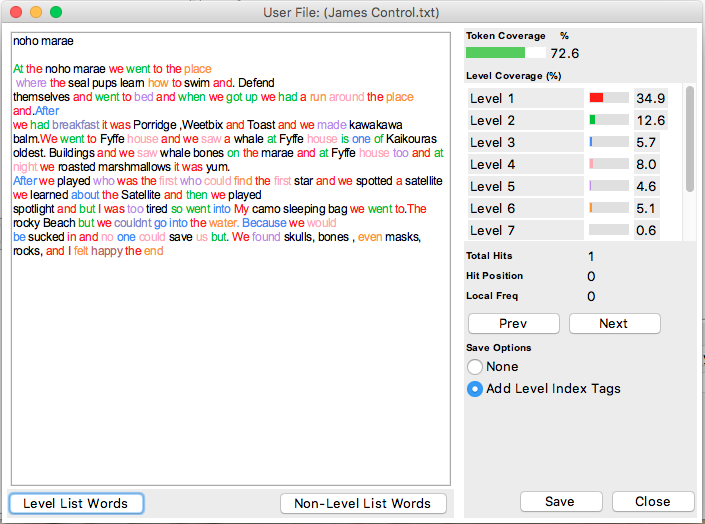
After analysing the data pushed out through Antword, this is how I have decided to summarise each child's baseline data.


File name: /Users/teacher 1/Desktop/James Control.txt
Number of types: 94
Number of tokens: 175
Type/Token ratio 53%

Statistics
Essential list
TOKENS
TOKEN%
CUMTOKEN%
TYPES
TYPE%
CUMTYPE%
1
61
34.86
34.86
10
10.64
10.64
2
22
12.57
47.43
12
12.77
23.41
3
10
5.71
53.14
7
7.45
30.86
4
14
8.00
61.14
9
9.57
40.43
5
8
4.57
65.71
6
6.38
46.81
6
9
5.14
70.85
8
8.51
55.32
7
1
0.57
71.42
1
1.06
56.38
8
2
1.14
72.56
2
2.13
58.51
Not on lists
48
27.43
99.99
39
41.49
100
TOTAL:
175

94


94

This sample text taken on  April 2016 shows that James used words from the 8 levels on the
essential lists for 73% coverage in his writing, the remaining 27% of words he has used are
not on the lists – These 48 words can be classed as high interest or topic related words.
Two were place names (Fyffe, Kaikoura) and three were kupu māori (noho, marae, kawakawa).
The aim is to see a further increase in the “off lists” usage of words that James is using to show
an increasing richness and wider use of vocabulary, beyond the essential lists. This will be reflected
in a higher type/token ratio and a higher percentage of coverage from “off list” words. In addition, new
word lists can be created from the control samples and post intervention samples and compared to show the growth
in word usage across the class.


Wednesday, April 13, 2016

Thanks goodness for digital technology

The analysis of the children's writing in as much detail as I require to deliver an intervention targeted at the root of this inquiry would not have been possible prior to the move to a digital learning environment. Why? Keep reading.......


There are never enough hours in the day as a teacher and if I had to re-type every piece of writing that the children had hand written, before using Antword Profiler to analyse the vocabulary used, I would not have been able to do this, it would taken too much time and not have been time efficient.

Thanks goodness for digital technology. 

Not only was this part of the analysis enabled through the use of digital technology but also the next part of the analysis as well. Imagine having to go through each piece of writing and count the number of words that appear in list 1, list 2 and so on through to list 8.   After that I would have had to count up the times that each word was repeated etc.  Time efficient, definitely not! Once again this intervention would  not have been possible without the move to a digital environment.

This is just the beginning of an exciting inquiry and the data that I have been able to gather and analyse to further inform my direction has only been made possible through a digital learning environment.


Digital Analysis Hiccup

Over the past few weeks I have been comparing a few vocabulary analysis digital tools to see which will be the best fit for my inquiry.

I have come across an awesome tool developed by Laurence Anthony called Antword Profiler. This piece of software is going to provide me with an in depth analysis of the children's writing that I will be able to use to inform my quantitative data in the initial stage. 

How does Antword Profiler work? Click on the link Antword Profiler to find out more about the tool.

I have had to adapt the tool to suit my inquiry as the lists that were developed to work in this programme were not going to be specific enough to enable me to see detailed movement in the progress of my children's writing throughout the inquiry. What does this mean? 

I had to create and import the Essential Word Lists 1-8 to use as a guideline as these are the lists that we use to teach spelling in my class.  - By the end of Y2 children should be expected to know all the words in List 1-2 , the end of Y4 - Lists 1-4, the end of Y6 - Lists 1-6, the end of Y8 Lists 1-7. In some cases children will have mastered all these words at an earlier stage. There will also be words that are not on these lists.

Antword did not work well with apostrophes, so on the lists I  collapsed or expanded those words eg. can’t is now cant etc but we’re is weare, I’m is Iam I’ll is Iwill and It’s is itis. Instances of these need to be modified in the child’s text before I load it into Antword.

Just a slight hiccup but easily solved.


Monday, March 21, 2016

Planning my timeline

Today was spent tidying up my proposal and organising a timeline. By setting mini goals linked to the Spark MIT hui each term, it will keep my inquiry on track.


I feel that today has given me clarity around the type of data that I will be using to inform my direction and where I had previously thought I would use eAsTTle data I am going to find out more about Paul Nation's Range Programme and see if this is a better fit.
I will have to begin with a control piece of writing which the tamariki will do next week and then begin my analysis.


Looking deeper into providing the virtual experiences I have come to the realisation that this means that I should not only expect children to increase their world of experiences according to 'Whaea Heather '- but that I need to broaden my knowledge of what experiences my learners DO have under their belt and in their life. It is a presumptuous thing for educators to say our kids have limited experiences and perhaps it is more a case of teachers having limited knowledge of what the children bring. My next mission is to work out - How do I uncover that??


This is AKO - theory of learning through reciprocity in action and it is exciting to be able to implement it explicitly in this inquiry. To further explain, if I am providing experiential input that I believe the tamariki need to improve their writing, I also need to have them provide input for me on their real life experiences so that I have my lens into their world sharpened By doing this I am asking them to actively engage with their regular experiences rather than be passive participants in life. 

Writing can be the authentic purpose for creating critical thinkers who are highly engaged in life. With me being that person that is vitally interested in their world, it will hopefully creates intrinsic thinkers. I believe it also shifts the ego and develops people who are interested in others and people who notice the perspective of others resulting in socially/emotionally responsive tamariki. I will need to be careful though not to overload them in the domain of sharing,as it can quickly become overwhelming and work against the goal. I will need to be the manager of this.


Mission 2 - In knowing the learner, if writing isn’t their preferred mode of communicating - how do I use their preferred mode and quietly encourage writing alongside?

The tamariki have really been enjoying having agency over their learning and I have been noticing that this power of choice or Mana whakahaere is making a huge difference to their task engagement. I hope to nurture and provide as much agency as possible.


Sunday, March 20, 2016

Student Voice - Is it what I thought it would be?

 To gather some student voice to inform my next steps.

My class are quite new at using google draw, but we thought we would give it a go as a way to gather information on what they like about writing and what they find difficult or are barriers for them when it came to tuhituhi time.


There was a variety of reoccurring comments from the tamariki mainly with struggling to find new words or sufficient words to make their stories interesting and also struggling with punctuation. This was great as my inquiry will be focussing on providing strategies to increase their vocabulary bank. I have a few strategies that I am pondering however I need to get a timeline in place with milestones along the way so that I don't miss anything and so that I can give this inquiry the time and depth of research that it needs.